



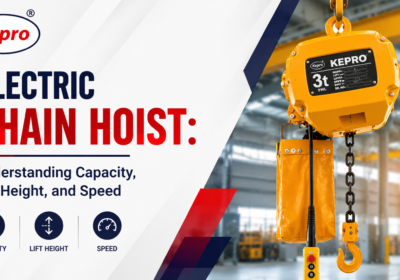
Overview – An electric chain hoist lifts and lowers loads using a motor-driven chain mechanism instead of manual effort, and three specifications, capacity, lift height, and speed, decide whether a given hoist actually suits the job it’s bought for. Get any one of these wrong and the result is either a hoist that can’t do the job safely or one that’s needlessly oversized, slow, and expensive to run.
Table Of Content
Introduction
Electric chain hoists show up everywhere from small fabrication shops to large warehouses and steel plants, and on the surface, most look fairly similar, a motor, a gearbox, a chain, and a hook. What separates a hoist that performs reliably for years from one that wears out early comes down to a handful of specifications that don’t always get the attention they deserve.
This blog covers the three specifications buyers ask about most, capacity, lift height, and speed, along with a few related factors that affect how well a hoist performs once it’s installed and working.
Capacity and Safe Working Load
Capacity is the specification most buyers check first, and it’s also the one most commonly misunderstood.
The rated capacity of an electric chain hoist refers to its safe working load, the maximum weight it’s designed to lift under normal conditions, and this figure already includes a built-in safety margin set by the manufacturer.
Choosing a hoist rated exactly at the maximum expected load leaves no room for variation in load weight, uneven distribution, or dynamic forces created during lifting, all of which push the effective load higher than the static weight suggests.
A hoist sized with reasonable headroom above the typical load, rather than right at the edge of its rated capacity, generally lasts longer and puts less strain on the motor, gearbox, and chain over repeated use.
Capacity ratings scale in standard increments, commonly 250 kg, 500 kg, 1 ton, 2 tons, 3 tons, and upward, and picking the next size up from a marginal calculation is almost always the safer, more cost-effective choice.
Lift Height and Headroom
Lift height determines how far the hook can travel from its highest to lowest point, and it needs to match both the application and the physical space available.
Standard lift heights typically range from around 3 meters for smaller shop applications up to 12 meters or more for tall warehouse or crane installations. Understanding the Hoist Working Principle can help buyers better understand how lift height affects the hoist’s operation.
Headroom, the vertical space required above the hook’s highest point for the hoist body itself, matters just as much as lift height, since a hoist that technically lifts high enough may still not fit where ceiling clearance is limited.
Low-headroom hoist models exist specifically for applications where the standard body height doesn’t leave enough clearance between the hook’s top position and the mounting structure above it.
Getting lift height and headroom right at the specification stage avoids a costly problem, a hoist that lifts loads only partway to where they need to go, or one that doesn’t physically fit the structure it’s meant to mount to.
Lifting Speed and Duty Cycle
Speed affects productivity directly, but a faster hoist isn’t automatically the better choice for every application.
Standard electric chain hoists typically lift at speeds between 4 and 8 meters per minute, while dual-speed models offer a slower speed for precise positioning and a faster speed for general lifting.
Duty cycle, expressed as a percentage or classification rating, describes how much of the time a hoist can operate under load without overheating, and it matters as much as raw lifting speed for frequent or continuous use.
A hoist with a low duty cycle rating used in a high-frequency application will overheat, trip its thermal protection repeatedly, and wear out well before its expected service life, even if capacity and speed looked sufficient on paper.
Matching duty cycle to actual usage pattern, occasional lifting versus near-continuous cycling, prevents this mismatch and is worth confirming explicitly.
Control Type and Operating Environment
How a hoist is controlled and where it operates both affect which model actually fits the application.
Pendant, remote, and pushbutton control options each suit different working environments, pendant control remains standard for most fixed installations, while remote control adds flexibility in larger spaces where the operator moves independently of the load.
Standard hoists are built for general indoor industrial use, but outdoor exposure, high humidity, dust, or corrosive atmospheres require hoists with appropriate protection ratings and, in some cases, specialized coatings or enclosures.
Explosion-proof electric chain hoist variants exist for hazardous environments like chemical plants or grain handling facilities, where a standard hoist’s electrical components would pose a genuine ignition risk.
Confirming the operating environment upfront, rather than defaulting to a standard indoor-rated hoist, avoids a mismatch that shows up later as premature electrical failure or a genuine safety issue.
Chain, Motor, and Brake Considerations
A few component-level details decide how well a hoist holds up under repeated, real-world use.
Load chains are typically hardened and tempered alloy steel, and chain grade directly affects how much load the chain can safely carry over its working life, independent of the hoist’s overall capacity rating.
Motor design, particularly whether it uses a single-speed or variable-frequency drive setup, affects both lifting smoothness and how well the hoist handles frequent starts and stops.
A reliable mechanical or electromagnetic brake is essential for holding a load securely in position, and brake quality matters more than most buyers expect, since brake failure is one of the more serious safety risks in lifting equipment.
Overload protection, typically a friction clutch or electronic load-sensing system, prevents the hoist from lifting beyond its rated capacity even if an operator misjudges a load’s weight, and it’s worth confirming rather than assumed.
Conclusion
Capacity, lift height, and speed are the specifications most buyers check first, but duty cycle, control type, operating environment, and component quality play just as large a role in how well the hoist performs once installed. A hoist that looks correctly specified on these three numbers alone can still underperform or fail early if any secondary factor was overlooked.
Sharing actual load requirements, lift height, duty cycle, and environmental conditions with an experienced manufacturer, rather than selecting purely off a capacity chart, generally leads to a more reliable outcome. Kepro India publishes detailed specifications for their electric chain hoist range at https://www.keproindia.com/electric-chain-hoist/, a useful reference when comparing options.
Frequently Asked Questions
How do I know what capacity electric chain hoist I need?
Start with the actual maximum load weight, then add a reasonable margin rather than sizing right at that figure. Uneven load distribution and dynamic lifting forces push the effective load above the static weight, so a hoist with headroom above the expected load lasts longer and operates more safely.
What’s the difference between lift height and headroom?
Lift height is the vertical distance the hook travels between its highest and lowest points. Headroom is the space the hoist body takes up above the hook’s highest position, and both need checking against the installation space, since a hoist can lift high enough and still not physically fit.
Why does duty cycle matter if the hoist already has enough capacity and speed?
Duty cycle describes how much continuous or frequent use a hoist can handle without overheating. A hoist with a low duty cycle rating used in a high-frequency application will overheat and wear out early, even if capacity and speed looked sufficient.
Do electric chain hoists need special models for outdoor or hazardous environments?
Yes. Standard hoists are built for indoor industrial use, and outdoor exposure, dust, humidity, or hazardous atmospheres typically require higher protection ratings or, in explosive environments, explosion-proof variants designed for that risk.


No Comment! Be the first one.